
AI assistant for public administration: within scope, within the rules
Helps one-stop officers look up procedures, processes and documents faster; helps citizens and businesses get clear answers; keeps professional knowledge when officers rotate. AI assists, the competent officer decides.
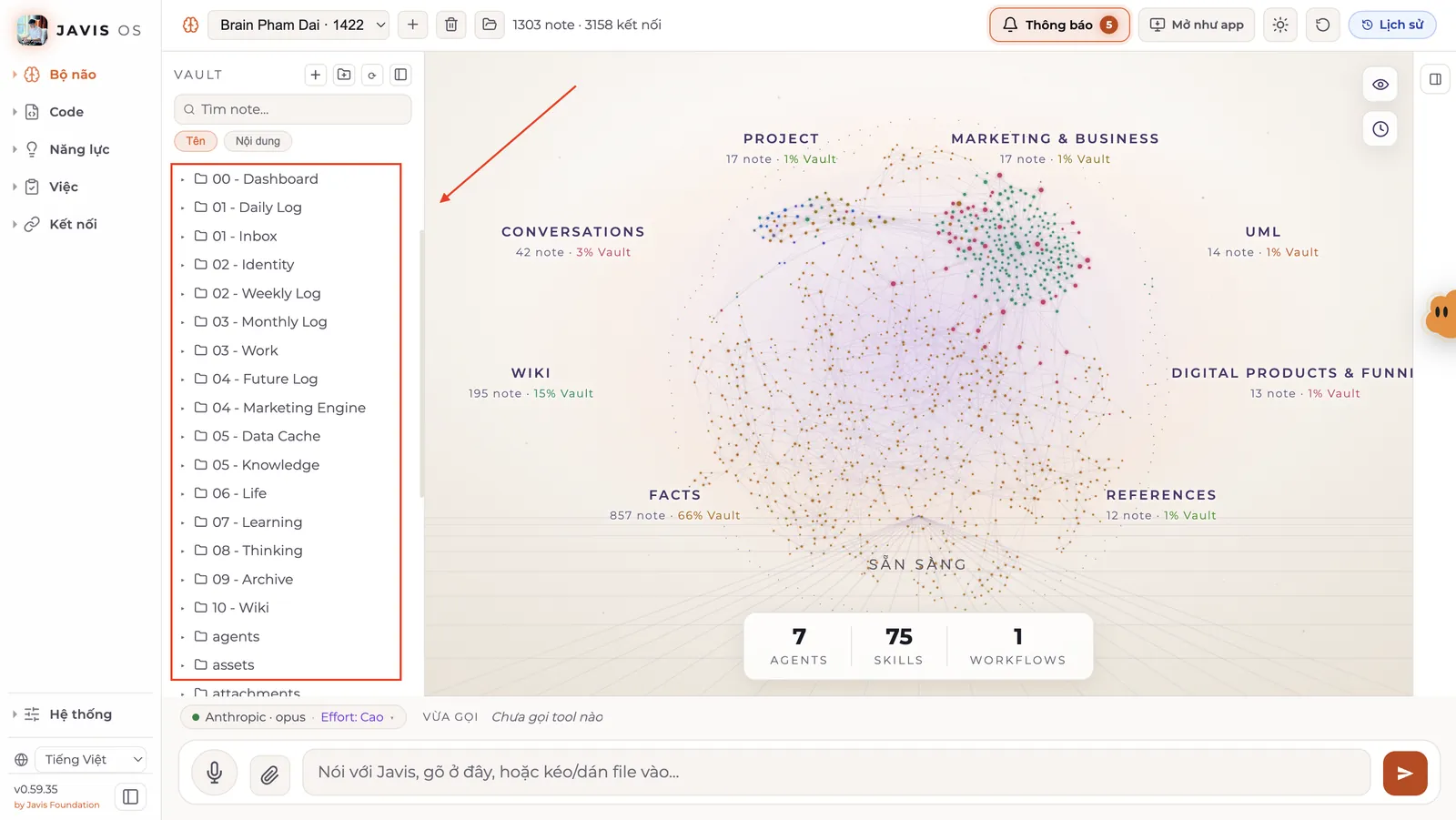
Illustration of the Javis OS interface with sample data.
Policies driving AI adoption in public services
AI in public administration already has clear direction and a regulatory framework. What matters is deploying it the right way.
Resolution 57-NQ/TW
Of 22/12/2024 of the Politburo on breakthroughs in science, technology, innovation and national digital transformation, including accelerating digital transformation in state agencies and public services.
Resolution 71/NQ-CP
Of 01/4/2025 of the Government, amending and supplementing the Action Program implementing Resolution 57-NQ/TW.
Decision 29/2026/QD-TTg
The first regulation on applying AI on the National Public Service Portal: automated guidance and answers; support for classifying and checking dossier completeness. AI results are for reference and support only and do not replace the decisions of competent agencies or persons.
Many procedures, changing regulations
Officers must remember and keep up to date with hundreds of procedures, dossier components and legal bases.
Repeated questions
Citizens ask the same thing many times, taking up the one-stop unit's time.
Missing documents that must be supplemented
Citizens make repeated trips because they have not grasped the full dossier components.
Rotation, loss of experience
Know-how sits in each officer's head and is hard to hand over completely.
Four modules for public administration
Each module deploys independently; you can pilot one area of procedures and then expand.
Procedure Q&A assistant
Answer common questions about public administrative procedures: dossier components, sequence, deadlines and where to submit. Works after hours, on channels chosen by the agency.
- Based only on public information approved by the agency
- States the source and tells people to contact an officer when beyond scope
- Fewer incomplete dossiers and fewer repeated questions
Professional assistant for one-stop officers
Look up regulations, suggest dossier checklists, draft notices and reply letters. Officers review, edit and remain responsible for the final content.
- Ask in natural language and get answers with the relevant clauses
- Drafts and summaries, nothing issued automatically
- Officers can review the cited sources
Knowledge base: from scattered documents to a linked wiki
Digitize processes, public internal guides, forms, common situations and how they are handled into a linked knowledge base retrievable in seconds.
- New officers get up to speed faster
- Keep experience handling situations
- Open markdown format; the agency keeps full control
Compile and report to stay on top of the situation
Compile figures from the sources the agency allows into periodic reports; help leaders keep track of case handling and common issues.
- Reads only the sources you have granted
- Reports with data sources attached
- Leadership checks before use
The images above illustrate the Javis OS interface with sample data; real content is built for each agency.
AI assists, humans decide
Does not replace authority
The assistant does not resolve cases or issue documents. Decisions belong to the competent officer or agency.
Sourced and verifiable
Every answer comes with cited sources so officers can cross-check before use.
Within the right data scope
Each module is only loaded with data types that fit the agreed classification level.
Owner organization
The system sits on the agency's infrastructure; knowledge is stored as open files with no vendor lock-in.
A different handling for each data level
We classify data together with the agency from the survey session and only deploy the option that fits each level.
Level 1 · State secrets
Never enter it into Javis OS or any AI system connected to the internet. The 2018 Law on Protection of State Secrets (Article 5) prohibits putting or spreading state secrets on the internet, computer networks or telecommunications networks. We do not process this type of data.
Level 2 · Internal, sensitive
Internal documents, personal data and unpublished dossiers. Deploy Javis OS on the agency's infrastructure with a locally run model (Ollama or an OpenAI-compatible endpoint managed by the agency); nothing is sent to public AI platforms.
Level 3 · Public, general
Legal documents, public administrative procedures and communication information. A cloud model can be used for high quality, with officers still checking the results.
Messaging channels operated overseas (such as Telegram) should only be used for level 3 data. For level 2, we recommend an internal channel controlled by the agency.
The regulations we follow
- 2018 Law on Protection of State Secrets (29/2018/QH14), Article 5: prohibited acts, including putting or spreading state secrets on the internet.
- Official Letter 557/BKHCN-CĐSQG (31/3/2025): general principles for officials and public employees using AI chatbots; do not share state secrets, sensitive information or internal documents; check results carefully; do not share official accounts.
- Official Letter 2766/BKHCN-TTCNTT (29/4/2026): state secret documents must not be entered into public AI platforms; internal AI solutions with access control, usage logging, backup and security monitoring are encouraged.
- Decision 29/2026/QD-TTg: applying AI on the National Public Service Portal; AI results are for reference and support only.
- 2024 Law on Data: state agencies classify data (shared/private/open; core/important/other); using a platform located overseas to process data collected in Vietnam is treated as a cross-border data transfer and is subject to separate conditions.
- 2025 Law on Personal Data Protection (91/2025/QH15, effective 1/1/2026) and 2025 Law on Artificial Intelligence (134/2025/QH15, effective 1/3/2026).
- Decree 61/2018/ND-CP (and the amending or replacing documents currently in force) on the one-stop and inter-agency one-stop mechanism for handling administrative procedures.
- Decree 85/2016/ND-CP and Circular 12/2022/TT-BTTTT: ensuring information system security by level. Determining the level and preparing the proposal dossier is the responsibility of the system owner.
Honest about scope
The content above is for reference and does not replace legal advice. Javis OS currently holds no information security certification or confirmation of security level. The platform has login, two-factor authentication, encrypted secret keys and attempt limits, but does not yet have built-in audit logs or multi-user role-based permissions. These requirements (as mentioned in Official Letter 2766) are assessed by us, with an additional solution proposed for each project. Deployment at each agency must be reviewed and approved under the owning agency's regulations.
Small pilot, controlled expansion
Survey & data classification
Work with leadership, the one-stop unit and the IT unit; identify priority procedure areas, data sources, classification levels and information security requirements.
Result: a survey report and a proposed planPilot one area
Build the brain and assistants for one group of procedures, and assess answer quality with specialist officers before expanding.
Result: a pilot assistant evaluated by officersExpansion & integration
Add fields, work channels and modules. Compatibility with the agency's existing systems is assessed separately for each project.
Result: an approved scope for expansionOfficer training & usage rules
Train officers and hand over a set of AI usage rules consistent with the guidance of the Ministry of Science and Technology.
Result: officers who operate it independentlyOperations & improvement
Update knowledge when regulations change, periodic reviews, technical support.
Result: a knowledge base that stays up to dateSolutions for each type of agency
Public administration service center
Officers must remember and keep up to date with hundreds of procedures, dossier components and legal bases.
View solutionSpecialized agencies, departments and bureaus
Documents, regulations and guides are in many places; finding the right clause takes time.
View solutionEvaluated with the agency's own indicators
Each pilot has a clear set of indicators so leadership can decide whether to expand.
Lookup time
Time for officers to find the right regulation and dossier components compared with before the pilot.
Incomplete dossiers
Share of dossiers that need supplementing because citizens have not grasped the guidance.
Repeated questions
Repeated questions at the counter and by phone are answered by the assistant.
Satisfaction level
Feedback from citizens, businesses and officers through a short survey.
Specific indicators and targets are agreed between the agency and MienTay Media before the pilot; we do not commit to a predetermined level of improvement.
Clear dossiers for the agency to approve
Each phase comes with documents for internal review and for seeking opinions from the competent authority.
Survey report
Current operations, data sources, risks and the proposed plan.
Data classification table
Divide data into 3 levels and the handling for each, as the basis for the technical plan.
AI usage rules
A set of rules for officers, consistent with the guidance of the Ministry of Science and Technology.
Training materials
Step-by-step guides and practice scenarios for each role.
Step by step, fitting the agency's processes
We provide technical information so the agency can prepare its proposal and cost estimate; the contractor selection method follows the agency's current regulations.
Survey & proposal
Assess the current state and propose a suitable plan.
- Operations and data survey
- Data classified into 3 levels
- Propose the architecture and AI model option
- Assess information security requirements
Pilot
Deploy a trial in one area to evaluate effectiveness.
- Build the brain and assistants for 1 area
- Evaluated with specialist officers
- Pilot results report
- Propose an expansion roadmap
Deployment & training
Expand and hand over to officers.
- Add more areas and modules
- Officer training, handover of usage rules
- Technical support, knowledge updates
Questions from state agencies
Can confidential documents be put into the system?
No. State secrets must not be put on the internet or public AI platforms. We do not process state secret data.
Does the assistant decide on its own how a case is resolved?
No. The assistant only supports lookup, advice and drafting. AI results are for reference only; decisions belong to the competent officer or agency.
Where is the data stored?
The brain is stored as markdown files on the agency's own server. For sensitive data, use locally run models so nothing is sent out. Cloud models only suit public data and must be assessed under the rules on cross-border data transfer.
Has the system been certified for information security?
Not yet. Determining the information system security level is the responsibility of the system owner under Decree 85/2016/ND-CP. We provide technical information for that process.
Are there usage logs and role-based permissions?
Not a built-in feature yet. We assess and propose an additional solution for each project, in line with requirements such as Official Letter 2766/BKHCN-TTCNTT.
Can it connect to the Public Service Portal or the existing one-stop software?
Connectivity depends on the interface and rules of each system; we assess it separately during the survey phase and make no commitment in advance.
Can officers who are not tech-savvy use it?
Yes. Officers ask in natural language. We train them and hand over a set of safe AI usage rules.
What does the cost include?
Javis OS is open source (MIT). Costs cover server infrastructure, AI models (local or cloud depending on the data level) and deployment and training services. Quoted after the survey.
Schedule a survey for your agency or unit
Leave your details and MienTay Media will contact you to discuss your needs and propose a suitable pilot plan.
The sign-up form below is currently in Vietnamese. Fields: type (business / state agency), organization name, contact person and title, phone/Zalo, email, staff size, priority areas, needs, and a required consent box. Prefer English? Email hello@mientaymedia.com or call 0976 788 840 (Zalo available) and we will reply in English.